Sleep materials · Mattress guide
How Natural Fillings Shape the Feel of a Vispring Mattress
A mattress is more than its spring count or firmness label. Wool, cotton, horsetail and other natural fibres form a layered landscape above the coils, influencing how a bed cushions the body, releases heat and responds as a sleeper moves through the night.
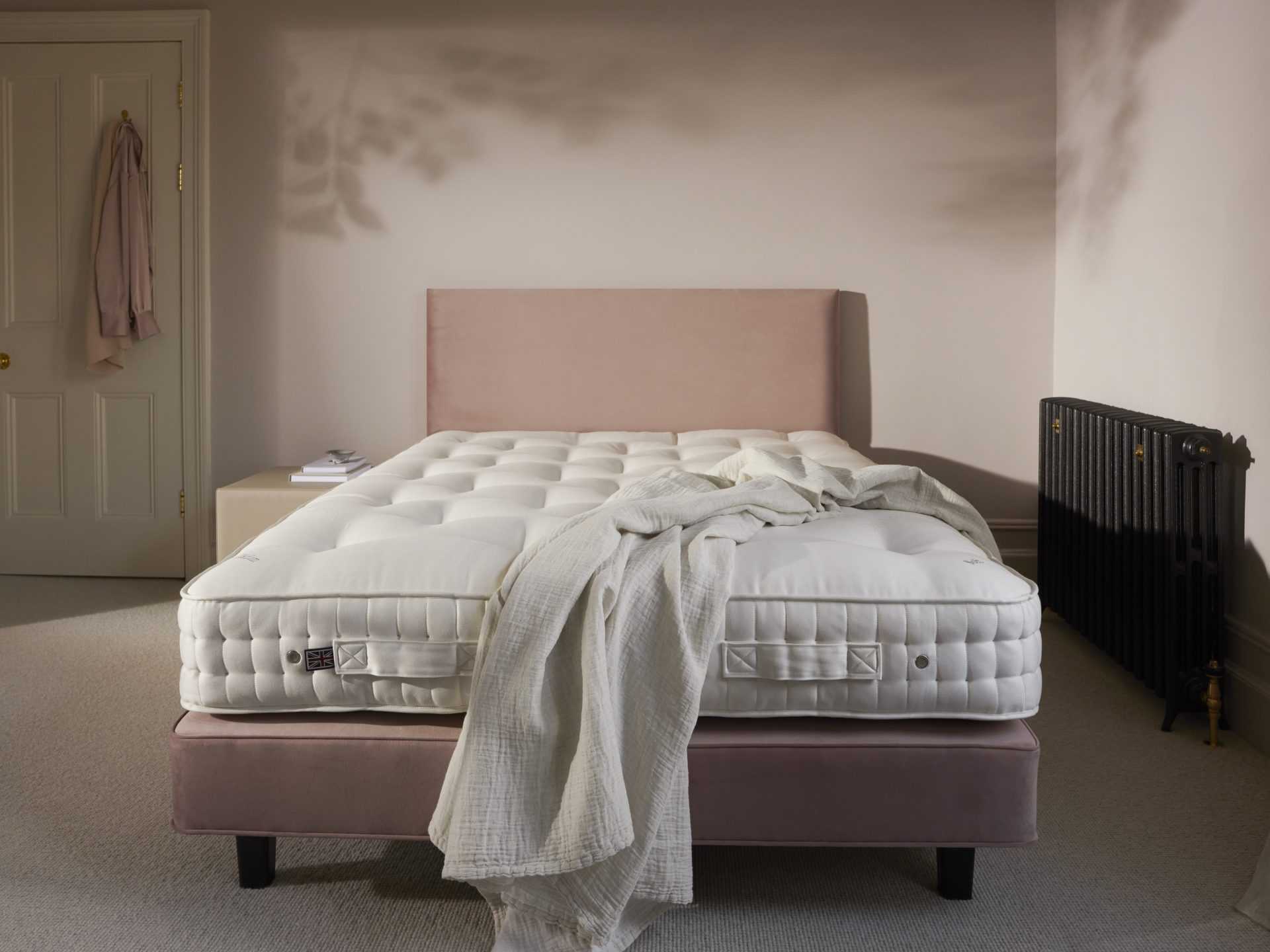
Lift the cover of a traditional mattress and the first thing you encounter is not a single material, but a sequence. Fine fibres sit close to the sleeper; denser layers lie nearer the springs; stitching and tufts hold the construction in place. Each layer has its own character, and together they help determine whether a mattress feels buoyant, softly cushioned, cool, substantial or some combination of these.
That is the useful way to think about natural mattress fillings. Wool, cotton, horsetail, silk and mohair are not interchangeable ingredients added simply to make a specification sound impressive. Their structure and placement can affect the sensation at the surface, the way warmth and moisture are managed, and how weight is carried towards the spring system. The final feel, however, also depends on the springs, the firmness selected, the sleeper’s body and the bed’s supporting base.
Vispring mattresses offer a range of filling combinations, from wool-and-cotton constructions to more elaborate upholstery stacks that include horsetail and fine animal fibres. Understanding what those materials generally contribute makes it easier to compare models on more than a name or a headline description.
A mattress works as a layered system
It is tempting to treat comfort as a choice between “soft” and “firm.” In practice, those words describe only part of the experience. A mattress can have a supportive spring core and a yielding surface, or a more immediately resilient top over a spring unit chosen for a different tension. Upholstery fibres shape the transition between the body and the springs.
Imagine the construction as a landscape with several contours. The surface layer determines the first impression: how the mattress welcomes the shoulder or hip when someone lies down. Layers beneath it add depth and resilience, helping distribute pressure before it reaches the coils. The spring system then provides the deeper response, moving under load and contributing to alignment and support.
The proportions matter. A fibre that feels light and springy when used in one layer can behave differently when blended with wool or placed above a denser foundation. Hand-tufting, stitching and the way fillings are secured also influence how consistently the layers stay in position. No single material, in isolation, tells the whole story.
For this reason, descriptions of luxury mattresses are most useful when read alongside their construction details. Ask what the fillings are, how they are arranged, what spring system lies beneath them, and which firmness options are available. The answer is a more complete picture than a label such as “plush” or “natural.”
Wool: breathable cushioning with a gentle give
Wool is one of the most familiar natural fillings in traditional mattress construction. Its fibres have a crimped structure that can create a soft, resilient layer, while wool’s ability to take up and release moisture vapour helps it interact with the changing conditions near the sleep surface. That does not mean wool controls room temperature or guarantees a particular sleep climate. Rather, it is a breathable material whose behaviour can contribute to a less clammy, more adaptable surface.
In a mattress, wool often provides cushioning without the quick, uniform compression associated with some dense foams. It can compress under pressure and recover, giving the surface a more organic, gently yielding quality. The sensation varies with the fibre, its preparation, its quantity and the materials around it. A generous wool layer may feel different from a tightly bonded wool-and-cotton blend, even though both use wool.
British fleece wool appears in several Vispring constructions. In the Vispring Elite, bonded British fleece wool and cotton form the upholstery on both sides, with a further blended layer beneath. The design keeps the filling profile relatively focused: natural fibres over a single layer of hand-nested pocket springs. This is a useful example of how wool and cotton can provide surface comfort while the springs remain central to the mattress’s support.
The Vispring Coronet Mattress also uses British fleece wool and cotton, arranged in layers above hand-nested calico pocket springs. The model offers a choice of soft, medium, firm or extra-firm spring tension, with split firmness available in king size. Those options are important: a natural-fibre surface does not determine the whole feel, and selecting spring tension helps tailor the support beneath it.
Wool may appeal to sleepers who prefer a breathable, cushioned surface that does not feel uniformly padded. Yet “wool-filled” is not a precise comfort rating. The amount and placement of wool, the firmness of the springs and the sleeper’s own proportions all influence how it feels in use.
Cotton: a steady, breathable partner
Cotton is often paired with wool rather than used as a stand-alone description of a mattress’s character. It can contribute a stable, breathable layer within an upholstery stack, complementing wool’s crimp and loft. In blends, the fibres work together as part of the overall filling rather than as separate comfort features that can be felt in isolation.
Bonded wool and cotton, for example, may provide a more even foundation for the layers above or a consistent surface beneath the ticking. The exact result depends on how the blend is made and where it sits. A layer near the surface may influence the initial touch; one closer to the springs may play a greater role in distributing load through the upholstery.
Because cotton is familiar from clothing and bedding, it can be easy to assume it will feel much the same in a mattress. But mattress fillings are thicker, layered and compressed under body weight. Their performance depends on construction, not simply on the fibre name. When comparing two models, look at the whole upholstery specification and the spring design rather than expecting the word “cotton” to predict softness by itself.
Horsetail: a more buoyant, springy character
Horsetail is valued in some traditional mattress fillings for its naturally coarse, resilient fibres. Unlike a uniformly soft layer, it can add a more buoyant quality to the upholstery. In a blend, its springiness may be moderated by softer fibres such as wool, creating a layered sensation that feels lively rather than simply plush.
The Vispring Regal Superb combines long-stranded horsetail with British fleece wool in the middle of its filling stack. Real Shetland wool and cotton sit nearer the sleep surface, while bonded British fleece wool and cotton form a stabilising layer closer to the springs. This arrangement illustrates why the position of a material matters as much as its identity: the sleeper encounters a succession of textures and responses, not a single fibre acting alone.
Horsetail is also part of the more complex upholstery in the Vispring Sublime Superb, alongside British fleece wool, Real Shetland wool, silk, mohair and organic cotton. The construction is paired with a two-layer pocket-spring system. Here, the overall feel emerges from the interaction of many fillings and the underlying support, rather than from horsetail alone.
“Springy” should not be mistaken for “soft,” nor does it mean the mattress will bounce in a way that disturbs a partner. The term describes the resilience that a fibre can contribute to the upholstery. How pronounced that sensation is depends on the amount of horsetail, the surrounding materials and the mattress’s full construction.
Silk, mohair and other fibres in the mix
Some higher-specification fillings combine several natural materials to create a more intricate balance of softness, loft and resilience. Silk and mohair, for instance, can contribute fine, supple fibres within an upholstery stack. Their role is shaped by where they are placed and what surrounds them; they are elements of a designed system, not a guarantee of a particular level of warmth or comfort.
In the Sublime Superb, silk and mohair appear alongside wool, horsetail and cotton. A mattress with this kind of varied composition may have a more complex surface character than a model using a simpler wool-and-cotton profile. Yet complexity is not automatically the same as suitability. The relevant question is whether the resulting feel, support and maintenance requirements suit the person who will sleep on it.
Natural fibres also vary. Wool can come from different sources and be processed in different ways; cotton may be blended or bonded; horsetail characteristics depend on its preparation. A product description gives a helpful map, but the written specification cannot fully reproduce the sensation of lying on the mattress.
The springs beneath the fillings still matter
Upholstery influences the contact layer, but the spring system helps determine how the mattress responds under a sleeper’s weight. Vispring models described here use pocket springs, in which individual springs sit within fabric pockets and can respond locally to pressure. The number and arrangement of springs, their tension and the mattress’s construction all contribute to the support profile.
The Coronet, for example, has a single row of hand-nested calico pocket springs, with 2,058 springs stated for a king size. The Elite uses a single layer of hand-nested pocket springs, with 1,716 in a king size. These figures describe a particular size and construction; they should not be treated as a simple ranking in which a higher count automatically means a better or more supportive mattress. Spring tension, layout, upholstery and fit to the sleeper all matter.
Independent pocket springs can help limit the direct transfer of movement from one part of a mattress to another, though the actual experience depends on the full bed and its occupants. Fillings add another dimension: their cushioning can affect how pressure is spread before it reaches the springs. In this way, upholstery and support are partners. Neither is a substitute for the other.
Firmness options are similarly contextual. A “firm” spring tension does not necessarily describe the exact sensation at the surface, while a plush filling does not automatically imply a lack of support. The best comparison is between complete mattress designs, ideally tested in the sleeping position and setup that most closely reflect everyday use.
Breathability, warmth and the sleeping environment
Sleep comfort is affected by more than the mattress. Room temperature, bedding, nightwear and individual differences all shape how warm a bed feels. Natural fillings are often chosen for their capacity to interact with moisture and air, but no filling can compensate for every room condition or personal preference.
Wool’s moisture-handling properties may help it feel more adaptable through changes in the night. Cotton can contribute to an open, breathable construction. Horsetail’s coarse structure and resilience give it a different role, while finer fibres can add softness and depth. Together, these characteristics inform the mattress’s microclimate and tactile feel, but they do not make precise promises about a sleeper’s body temperature.
For a fair assessment, consider the whole sleep system: mattress, base, sheets, duvet and room. A warm duvet can overwhelm the differences between two mattress fillings. Likewise, a mattress placed on an unsuitable or incompatible base may not perform as intended. Product specifications and care instructions should be checked for the exact model and base combination.
A practical way to compare natural mattress fillings
When comparing Vispring mattresses or other luxury mattresses, a few questions can turn a long material list into useful information:
- What is the first layer? Identify what sits closest to the ticking and consider how it may shape the initial surface feel.
- How are the fillings layered? A blend above the springs may behave differently from the same fibres placed near the surface.
- What is the spring construction? Check whether the mattress uses one or more spring layers and what firmness options are offered.
- Is the mattress suitable for both sleepers? If two people share the bed, consider differing preferences, body shapes and whether split firmness is available.
- What care does it require? Follow the manufacturer’s guidance on turning, rotation, ventilation and compatible bases.
- Can you try it in person? A product description explains materials; lying on the mattress helps you judge the actual combination of surface cushioning and deeper support.
It can help to focus on sensations rather than terminology. Does the surface feel immediately yielding or more buoyant? Do shoulders and hips settle comfortably in a side-sleeping position? Does the mattress feel supportive without creating uncomfortable pressure? These observations are more useful than trying to infer a precise experience from a fibre name alone.
Craftsmanship and the life of the filling stack
Natural fillings need to remain in the places where they are meant to work. Hand-tufting can help anchor upholstery layers through the depth of a mattress, while side-stitching reinforces the border. These techniques are part of construction, not surface decoration: they help manage the relationship between the filling stack and the mattress’s shape.
In the Coronet, hand-tufting with felt washers secures the layers, and two rows of hand side-stitching reinforce the border. The Elite is also hand-tufted and side-stitched. Such details do not remove the need for correct care, nor can they promise that a mattress will retain an identical feel indefinitely. They do, however, help explain how traditional mattress-making techniques support the structure of the finished product.
Mattress longevity depends on use, the supporting base, care and the materials themselves. Follow the model-specific instructions, since turning or rotation recommendations can differ. Use a base designed to support the mattress and keep the sleeping surface ventilated in line with the manufacturer’s advice. These everyday practices help preserve a consistent sleep surface over time.
Choosing the feel that suits you
There is no universally ideal filling. A sleeper who values a soft, gently cushioned surface may prefer a different upholstery profile from someone seeking a more buoyant feel. People who share a bed may need to balance distinct comfort preferences, while sleeping position and body proportions affect how pressure is distributed across the mattress.
Begin with the experience you want, then use the material specification to understand how a mattress may approach it. Wool and cotton appear in relatively focused constructions such as the Elite and Coronet. The Regal Superb combines wool with horsetail in a broader filling profile. The Sublime Superb incorporates a more varied selection of fibres with a two-layer spring system. These distinctions provide a starting point for comparison, not a substitute for trying the mattress.
Keep the support question in view. Comfort is not simply softness, and a luxurious list of materials cannot determine whether a mattress is right for an individual. Consider firmness options, spring construction, bed size and base compatibility together. If a medical condition affects sleep or mobility, seek appropriate professional advice rather than relying on a mattress description to promise a health outcome.
The character of a mattress is made layer by layer
Natural fillings give a mattress much of its texture and atmosphere. Wool can add breathable cushioning; cotton can help form a stable, airy blend; horsetail can bring a resilient, buoyant quality; and finer fibres such as silk or mohair can contribute to a more intricate upholstery profile. Their effects are shaped by the amount used, their placement and the layers around them.
In Vispring mattresses, those fillings sit above carefully specified spring systems and are secured through established construction methods. The result is not determined by a single headline material, but by the relationships among fibre, spring tension, mattress design and sleeper. Reading those relationships makes the choice clearer—and helps turn a list of ingredients into a more meaningful picture of how a bed may feel night after night.